

How to use the Moment Of Inertia Apparatus to measure the moment of inertia of a ring?
Leave a message

The moment of inertia is a fundamental concept in physics, describing an object's resistance to changes in its rotational motion. Measuring the moment of inertia of a ring can be achieved using a Moment Of Inertia Apparatus. As a supplier of this apparatus, I'm here to guide you through the process step - by - step.
Understanding the Moment of Inertia Apparatus
The Moment Of Inertia Apparatus Moment Of Inertia Apparatus is a specialized device designed to measure the moment of inertia of various objects. It typically consists of a rotating platform, a pulley system, a hanging mass, and a timing mechanism. The basic principle behind its operation is based on the relationship between torque, angular acceleration, and moment of inertia, which is given by the equation (\tau = I\alpha), where (\tau) is the torque applied to the object, (I) is the moment of inertia, and (\alpha) is the angular acceleration.
Preparing the Experiment
Before using the Moment Of Inertia Apparatus to measure the moment of inertia of a ring, you need to ensure that the apparatus is properly set up.
- Inspect the Apparatus: Check all the components of the apparatus for any signs of damage or wear. Make sure the rotating platform rotates smoothly and the pulley system is functioning properly.
- Level the Platform: Use a spirit level to ensure that the rotating platform is perfectly horizontal. This is crucial because an uneven platform can introduce errors in the measurement.
- Attach the Ring: Carefully place the ring on the rotating platform. Make sure the ring is centered on the platform to ensure uniform rotation.
Measuring the Moment of Inertia of the Ring
The following steps will guide you through the process of measuring the moment of inertia of the ring using the Moment Of Inertia Apparatus:
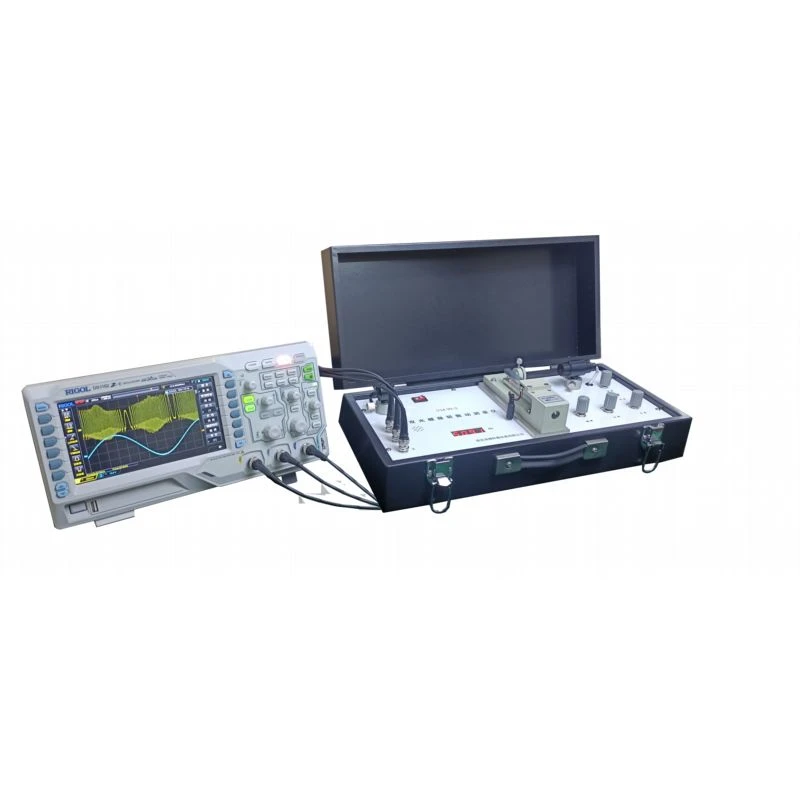

- Determine the Mass and Dimensions of the Ring: Use a balance to measure the mass (m) of the ring. Then, use a caliper to measure the inner radius (r_1) and the outer radius (r_2) of the ring. The theoretical moment of inertia of a ring about its central axis is given by the formula (I_{theoretical}=\frac{1}{2}m(r_1^{2}+r_2^{2})).
- Set up the Hanging Mass: Attach a known mass (M) to the end of a string and pass the string over the pulley of the apparatus. The weight of the hanging mass (Mg) will create a torque on the rotating platform.
- Measure the Angular Acceleration: Release the hanging mass and use the timing mechanism of the apparatus to measure the time (t) it takes for the mass to fall a certain distance (h). The linear acceleration (a) of the hanging mass can be calculated using the kinematic equation (h = v_0t+\frac{1}{2}at^{2}), where (v_0 = 0) (starting from rest). The angular acceleration (\alpha) of the rotating platform is related to the linear acceleration (a) by the equation (a = r\alpha), where (r) is the radius of the pulley.
- Calculate the Torque: The torque (\tau) applied to the rotating platform is equal to the product of the tension in the string (T) and the radius of the pulley (r). The tension (T) can be calculated using Newton's second law for the hanging mass (Mg - T=Ma).
- Determine the Moment of Inertia: Using the equation (\tau = I\alpha), we can solve for the moment of inertia (I) of the ring and the platform combined. To find the moment of inertia of the ring alone, we need to subtract the moment of inertia of the platform (which can be measured separately) from the total moment of inertia.
Sources of Error and Precautions
There are several sources of error that can affect the accuracy of the measurement. Some of these include friction in the pulley and the rotating platform, air resistance, and errors in measuring the mass and dimensions of the ring. To minimize these errors, you can take the following precautions:
- Lubricate the Pulley: Apply a small amount of lubricant to the pulley to reduce friction.
- Use a Low - Friction Platform: Make sure the rotating platform has a low coefficient of friction to minimize the effect of friction on the measurement.
- Repeat the Experiment: Perform the experiment multiple times and take the average of the results to reduce random errors.
Related Apparatuses
In addition to the Moment Of Inertia Apparatus, there are other mechanical testing instruments that can be used in physics experiments. For example, the Instrument for Measuring Liquid Viscosity is used to measure the viscosity of liquids, which is an important property in fluid mechanics. The Young Modulus Experiment Apparatus is used to measure the Young's modulus of a material, which is a measure of its stiffness. The Weak Vibration Measurement Apparatus is used to measure weak vibrations, and the Apparatus for Simple Pendulum is used to study the motion of a simple pendulum.
Conclusion
Measuring the moment of inertia of a ring using the Moment Of Inertia Apparatus is a valuable experiment in physics. It not only helps us understand the concept of moment of inertia but also allows us to verify the theoretical formula for the moment of inertia of a ring. By following the steps outlined in this blog and taking the necessary precautions, you can obtain accurate results.
If you are interested in purchasing a Moment Of Inertia Apparatus or any of the related mechanical testing instruments, please feel free to contact us for more information and to discuss your specific requirements. We are committed to providing high - quality products and excellent customer service.
References
- Halliday, D., Resnick, R., & Walker, J. (2014). Fundamentals of Physics. Wiley.
- Serway, R. A., & Jewett, J. W. (2018). Physics for Scientists and Engineers with Modern Physics. Cengage Learning.


