

Optical Instruments for Physics Teaching and Laboratory Experiments
1. Optical Instruments for Physics Teaching
We develop and manufacture optical instruments for physics teaching and laboratory experiments. Our product range covers liquid crystal electro-optic effects, photoelectric effects, light speed measurement, solar cell characterization, diffraction, interference, Newton's rings, and optical lens assembly.
Our optical instrument range includes:
- Liquid Crystal Electro-Optic Effect Experimental System
- Photoelectric Effect Apparatus
- Speed of Light Measurement Apparatus
- Solar Cell Characterization Apparatus
- Diffraction Intensity Measurement Apparatus
- Double Prism Interference Apparatus
- Newton's Ring Experimental Apparatus
- Prism and Lens Experiment Set
- Zeeman Effect Experimental Apparatus
Each instrument is designed around a specific experimental subject and optical arrangement. This allows laboratories to select individual equipment according to their teaching experiments rather than purchasing a general-purpose optical setup.


2. Optical Instruments and Their Experimental Functions
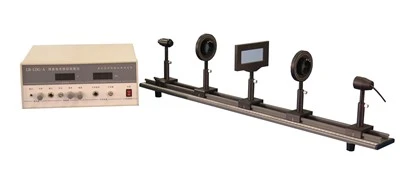
2.1 Liquid Crystal Electro-Optic Effect Experimental System (LB-LDG-A)
The LB-LDG-A uses a 650 nm semiconductor laser, polarizer, analyzer, TN-type liquid crystal panel, and high-speed photovoltaic receiver to demonstrate liquid crystal electro-optic effects.
Students can adjust the polarizer and analyzer, as well as the panel's driving voltage and frequency, to investigate changes in light transmittance and liquid crystal response.
The system measures light-on to light-off response times of 10–15 ms and light-off to light-on response times of 25–30 ms. Its liquid crystal panel measures 35 × 80 mm and can rotate horizontally through 0–360°.
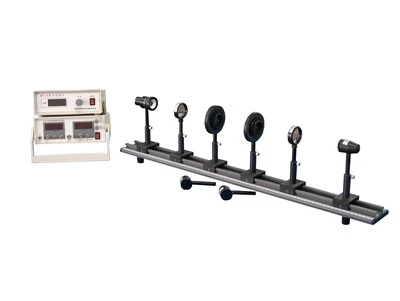
2.2 Photoelectric Effect Apparatus (LM07-B)
The LM07-B is configured for experiments involving photosensitive resistors, photodiodes, and photovoltaic cells.
Its optical arrangement includes an LED white light source, two imaging lenses with 100 mm focal length, two polarizing plates, and a silicon photovoltaic receiver measuring 10 × 10 mm. The optical rail is 0.8 m long.
The electrical components include an adjustable external DC voltage supply, variable resistor, galvanometer, and digital ammeter. This configuration supports measurements of photoelectric device characteristics and photovoltaic response under different experimental conditions.
2.3 Speed of Light Measurement Apparatus (LM3000A)
The LM3000A measures the speed of light using the phase method and Lissajous figure method.
Its setup combines modulated light, an adjustable optical path, and phase measurement. The optical path can be adjusted from 0 to 1 m, while the phase shift range is 0–180°. The instrument has a measurement accuracy of ≤3%.
An additional transparent rod is available for experiments involving refractive index measurement or light propagation through a medium.
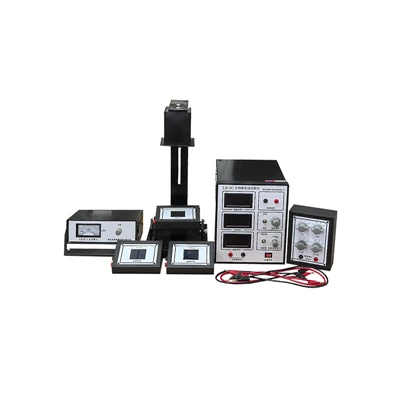
2.4 Solar Cell Characterization Apparatus (LB-SC-A)
The LB-SC-A allows students to investigate the electrical characteristics of monocrystalline silicon, polycrystalline silicon, and amorphous silicon solar cells.
Each solar cell panel has an effective area of 42 × 42 mm. A 60 W tungsten lamp provides continuously adjustable illumination, and the panel inclination can be adjusted from 0 to 60°. These adjustments provide different conditions for studying solar cell output characteristics.
The standard configuration includes a control box, main unit, three solar cell panels, light power meter, resistance box, and light shield. Voltage and current measurement instruments are also included.
2.5 Diffraction Intensity Measurement Apparatus (LM99)
The LM99 uses a 650 nm laser diode and a linear CCD detector with 2,700 photosensitive elements to collect diffraction intensity distributions.
Its grating assembly includes seven groups with 14 patterns. Three movable slide assemblies provide positioning adjustments: two slides have single-axis movement, while the third has three-axis movement. The grating holder also provides lateral adjustment over 70 mm, with vernier positioning accuracy of 0.1 mm.
This arrangement gives students a practical setup for comparing diffraction intensity distributions produced by different grating patterns.
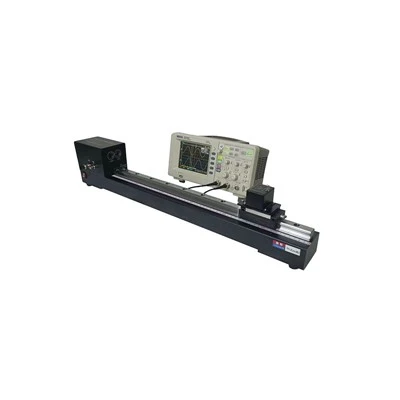
2.6 Double Prism Interference Apparatus (LM05)
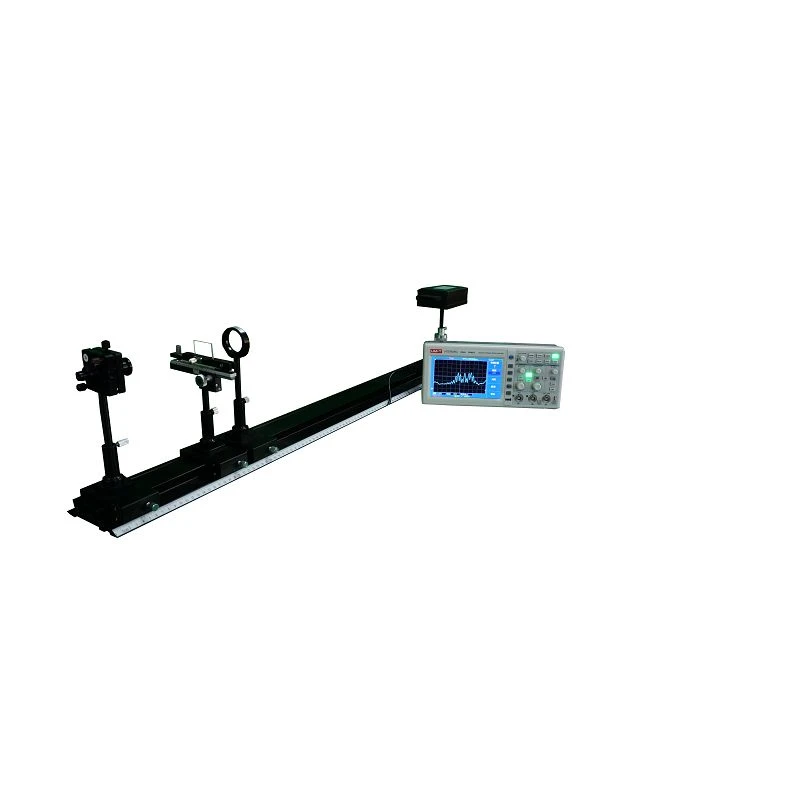
The LM05 combines a 650 nm laser, cylindrical lens, double prism, and linear CCD detector for double-prism interference experiments.
The double prism measures 30 × 20 × 3 mm and has three degrees of freedom for adjustment. The CCD detector has 2,700 photosensitive elements and collects the interference intensity distribution. An oscilloscope is used to observe and analyze the collected data.
The 100 cm optical rail provides the mounting base for the optical components.
2.7 Newton's Ring Experimental Apparatus (LM08-B)
The LM08-B is designed for observing Newton's rings in reflected and transmitted light arrangements.
A CCD microscope with 60× magnification is used to observe the ring patterns, while an electronic micro-displacement ruler provides displacement measurements with a minimum resolution of 0.01 mm. The apparatus also includes a 587.6 nm yellow LED light source with adjustable intensity.
An optional wedge interference attachment is available for thin-film thickness measurement experiments.
2.8 Prism and Lens Experiment Set (LM06)
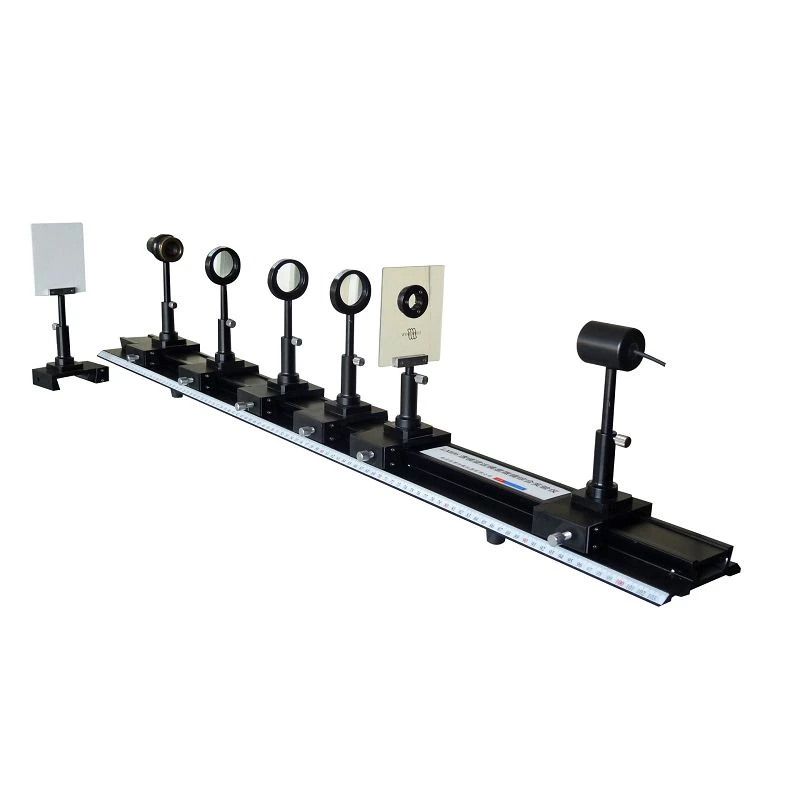
The LM06 provides optical components for assembling and studying different optical instruments. Its aluminum optical rail carries seven movable holders, allowing users to position the lenses and other components along the rail.
The set includes two convex lenses with focal lengths of 100 mm and 150 mm, one concave lens with a focal length of -50 mm, an object screen, and an eyepiece. A German white LED light source with adjustable intensity provides illumination for the experiments.
Using these components, students can assemble Galilean telescopes, Keplerian telescopes, internally focusing telescopes, and microscopes.
3. Technical Specifications
The following specifications are model-specific. They are provided to help laboratories compare equipment and identify the required experimental configuration.
| Product | Technical specifications |
|---|---|
| LB-LDG-A | Semiconductor laser wavelength: 650 nm; adjustable power: 0–3 mW; polarizer and analyzer rotation: 360° each; graduation: 1°; TN liquid crystal panel: 35 × 80 mm; horizontal rotation: 0–360°; driving frequency: 60–120 Hz; driving voltage: 0–11 V; 3.5-digit voltmeter resolution: 10 mV; current meter resolution: 10 μA; light-on to light-off response: 10–15 ms; light-off to light-on response: 25–30 ms. |
| LM07-B | Photovoltaic cell voltage: 0–0.5 V; external adjustable DC voltage: 0–10 V; variable resistance: 0–10 kΩ; galvanometer current range: 0–2000 μA; two polarizing plates, 1° graduation; two imaging lenses, focal length: 100 mm; silicon photovoltaic receiver: 10 × 10 mm; spectral response: 0.3–0.9 μm; 3.5-digit digital ammeter resolution: 1 nA; optical rail length: 0.8 m; LED white light source. |
| LM3000A | Measurement methods: phase method and Lissajous figure method; instrument length: 0.8 m; adjustable optical path: 0–1 m; phase shift range: 0–180°; resolution: 0.2 mm; modulation frequency: 150 MHz; phase detection frequency: 455 kHz; phase-shift rail length: 600 mm; flatness and parallelism: 0.02 mm; measurement accuracy: ≤3%; power: 8 W; prism slide: vertically adjustable. |
| LB-SC-A | Solar cell types: monocrystalline silicon, polycrystalline silicon, and amorphous silicon; effective panel area: 42 × 42 mm each; maximum voltage: 2.5 V; maximum short-circuit current: 130 mA; spectral response: 300–1000 nm; peak wavelength: 700 nm; tungsten lamp: 60 W, continuously adjustable light intensity; panel inclination: 0–60°; resistance box multipliers: ×1, ×10, ×100, ×1000; 3.5-digit voltmeter: 19.9 V range, 0.01 V accuracy; 3.5-digit ammeter: 19.9 mA range, 0.01 mA accuracy. |
| LM99 | Aluminum optical rail: 100 cm, black matte surface; laser diode: 650 nm; linear CCD: 2,700 photosensitive elements; spectral response: 0.3–0.9 μm; spatial resolution: 11 μm; grating groups: 7, with 14 patterns; lateral adjustment: 70 mm; vernier positioning accuracy: 0.1 mm; slide assemblies: two single-axis and one three-axis. |
| LM05 | Aluminum optical rail: 100 cm, black anti-reflection surface; laser: 650 nm; cylindrical lens; linear CCD: 2,700 photosensitive elements; spectral response: 0.3–0.9 μm; spatial resolution: 11 μm; double prism: 30 × 20 × 3 mm; three degrees of freedom adjustment; lateral adjustment: 70 mm; positioning accuracy: 0.1 mm; lens focal length: 150 mm. |
| LM08-B | Aluminum optical rail: 70 cm, black anti-reflection surface; yellow LED wavelength: 587.6 nm, adjustable intensity; electronic micro-displacement ruler minimum resolution: 0.01 mm; CCD microscope magnification: 60×; horizontal resolution: 600 TV lines; field of view: ≥9 mm; Newton's ring assembly diameter: 42 mm; condenser diameter: 38 mm; condenser focal length: 150 mm; curvature radius measurement error: ≤3%; operating voltage: 220±5 V AC, 50 Hz; total power: ≤10 W. |
| LM06 | Aluminum optical rail width: 104 mm, black anti-reflection surface; 7 aluminum movable holders; German white LED light source, diameter: 28 mm, adjustable intensity; two convex lenses, diameter: 38 mm, focal lengths: 100 mm and 150 mm; one concave lens, diameter: 38 mm, focal length: -50 mm; object screen: 80 × 110 mm; eyepiece focal length: 50 mm; metal eyepiece tube length: 65 mm. |
4. Model-Specific Optional Accessories
Two optional accessories are specified for individual models:
| Product | Optional accessory | Experimental use |
|---|---|---|
| LM3000A | Additional transparent rod | Refractive index measurement or light propagation through a medium |
| LM08-B | Wedge interference attachment | Thin-film thickness measurement |
Other components described in the product specifications and configurations belong to their respective model setups.
5. Optical Instrument Manufacturing and Quality Management
We have been engaged in physics experimental teaching equipment since 1999. Our manufacturing facility develops and produces experimental instruments across mechanics, thermodynamics, acoustics, optics, electricity, and new energy.
Our technical and R&D teams work on physics experimental teaching equipment. Our equipment includes oscilloscopes, frequency counters, machine tools, program simulation equipment, and programming instruments.
Our company information also records technical development activities, patent achievements, and a quality management system.
6. Product Consultation and Supply Support
We provide one-to-one consultation before purchase to discuss product selection and configuration requirements.
Our support includes packaging communication, production progress updates, and after-sales follow-up. For laboratories and project purchasers, we can discuss the required product models and equipment lists before preparing a quotation.
7. Request a Quote
- Contact us with the optical instrument models or experimental equipment you are interested in. You can also share the intended laboratory use or required accessories.
- We will review your inquiry and provide relevant product and quotation information.
- Contact us to discuss your optical instrument requirements.
As one of the most professional optical instruments manufacturers and suppliers in China, we're featured by quality products and good service. Please rest assured to buy customized optical instruments from our factory. If you have any enquiry about pricelist, please feel free to email us.
optical instruments, Photoelectric Effect Apparatus, Speed Of Light Measurement Apparatus