

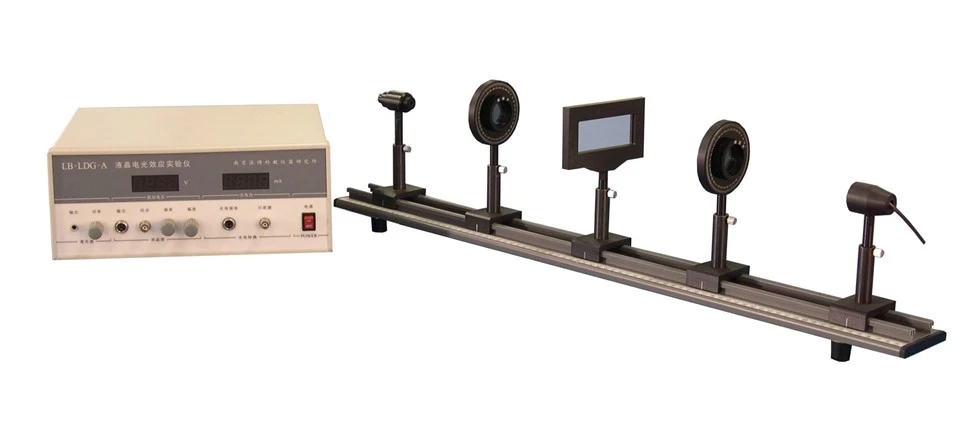
Experimental System for LC Electro‑Optic Effect
The LB-LDG-A Liquid Crystal Electro-Optic Effect Experimental System is made for teaching how liquid crystals work with light and electricity. The light source is a semiconductor laser with a wavelength of 650nm. Its power is adjustable from 0 to 3mW. A polarizer and an analyzer are both included. Each can rotate 360 degrees with a division value of 1 degree.
Description
The LB-LDG-A Liquid Crystal Electro-Optic Effect Experimental System is made for teaching how liquid crystals work with light and electricity. The light source is a semiconductor laser with a wavelength of 650nm. Its power is adjustable from 0 to 3mW. A polarizer and an analyzer are both included. Each can rotate 360 degrees with a division value of 1 degree. The liquid crystal material is the TN type. The liquid crystal panel measures 35mm × 80mm. This panel can rotate horizontally from 0 to 360 degrees. The Experimental System for LC Electro‑Optic Effect provides a wide range of driving frequencies and voltages. The driving frequency range is 60 to 120Hz. The driving voltage range is 0 to 11V. A 3.5-digit digital voltmeter shows the driving voltage with a resolution of 10mV.
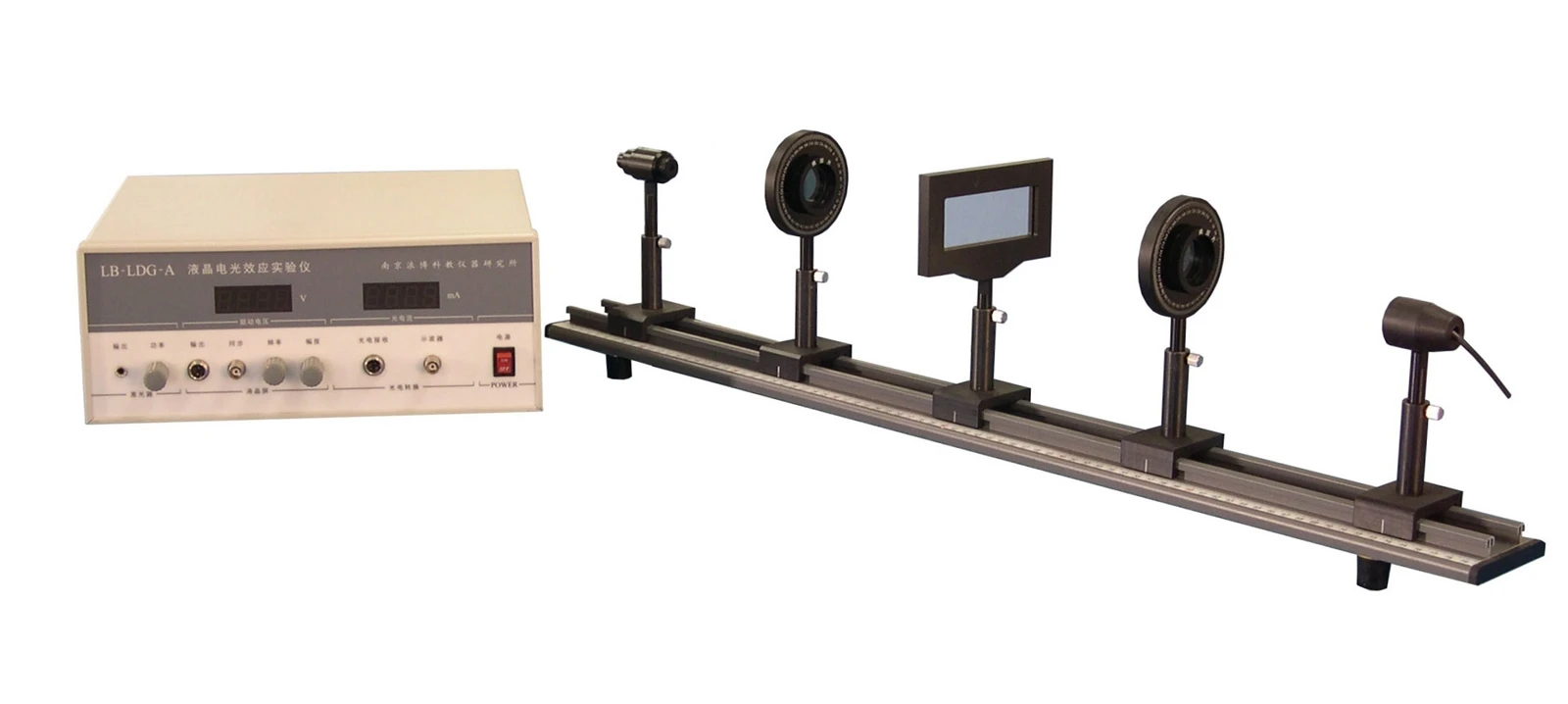
High Precision and Easy Measurement
The photoelectric receiver is a high-speed photovoltaic cell. A 3.5-digit digital current meter shows the photocurrent. The resolution is 10μA. All components are placed on an optical bench. This makes the system very flexible to use. One key feature of the Experimental System for LC Electro‑Optic Effect is that you do not need a storage oscilloscope. A standard general-purpose oscilloscope is enough to measure the rise and fall response times. The switching speed from bright to dark is 10 to 15ms. The switching speed from dark to bright is 25 to 30ms. This system allows students to perform three main experiments. First, you can measure the threshold voltage and saturation voltage of the liquid crystal optical switch. You can also draw the complete electro-optic switching characteristic curve. Second, you can measure the response time of the liquid crystal optical switch and draw the rise and fall response curves. Third, you can measure the transmittance of the liquid crystal optical switch and observe how the transmittance changes with different viewing angles.
Ideal for University Physics Labs
The LB-LDG-A Liquid Crystal Electro-Optic Effect Experimental System gives students a deep understanding of liquid crystal display technology. It combines optics, electronics, and materials science in one experiment. The system is easy to set up and use. The rotating polarizers and liquid crystal panel allow precise angular adjustments. The digital readouts for voltage and current provide clear, real-time data. This system is a reliable choice for teaching modern physics and engineering students about electro-optic effects.
Specifications Table
| Parameter | Value |
| Light source | Semiconductor laser |
| Laser wavelength | 650nm |
| Laser power range | 0 – 3mW adjustable |
| Polarizer rotation range | 360° |
| Analyzer rotation range | 360° |
| Rotation division value | 1° |
| Liquid crystal material | TN type |
| Liquid crystal panel size | 35mm × 80mm |
| Panel horizontal rotation range | 0 – 360° |
| Driving frequency range | 60 – 120Hz |
| Driving voltage range | 0 – 11V |
| Driving voltage display | 3.5-digit digital voltmeter |
| Voltage display resolution | 10mV |
| Photoelectric receiver | High-speed photovoltaic cell |
| Photocurrent display | 3.5-digit digital current meter |
| Current display resolution | 10μA |
| Bright-to-dark switching speed | 10 – 15ms |
| Dark-to-bright switching speed | 25 – 30ms |
Hot Tags: experimental system for lc electro‑optic effect, China experimental system for lc electro‑optic effect manufacturers, suppliers, factory, Diffraction Intensity Measurement Apparatus, Interference And Diffraction Apparatus, Newton s Ring Experiment Apparatus, optical instruments, Prism And Lens Experiment Set, Speed Of Light Measurement Apparatus
Send Inquiry
You Might Also Like
-

LM07-B Photosensitive Device Comprehensive Experimen...
-

LM3000A Light Speed Measurement Apparatus(phase method)
-

LM99 diffraction and interference intensity Measure...
-

ZM2000F Zeeman Effect Experiment Apparatus
-

Newton's Ring Experiment Apparatus
-

LM06 Comprehensive Optical Experiment Kit (Lenses, T...